Rethinking Requirements Engineering in the Age of AI
Foundation models and autonomous agents are changing how software is conceived, built, and evolved. As implementation accelerates, the challenge shifts towards deciding what to build, whose needs it should serve, and how to establish that it behaves as intended. Without effective Requirements Engineering (RE), we risk building the wrong system, faster.
RAISE 2027: The Third International Workshop on Requirements Engineering for AI-powered SoftwarE brings together researchers and practitioners to rethink RE for this changing landscape. We explore both requirements for AI-powered software (AIware) and how humans and AI can work together to engineer software that meets stakeholder needs and aligns with societal values.
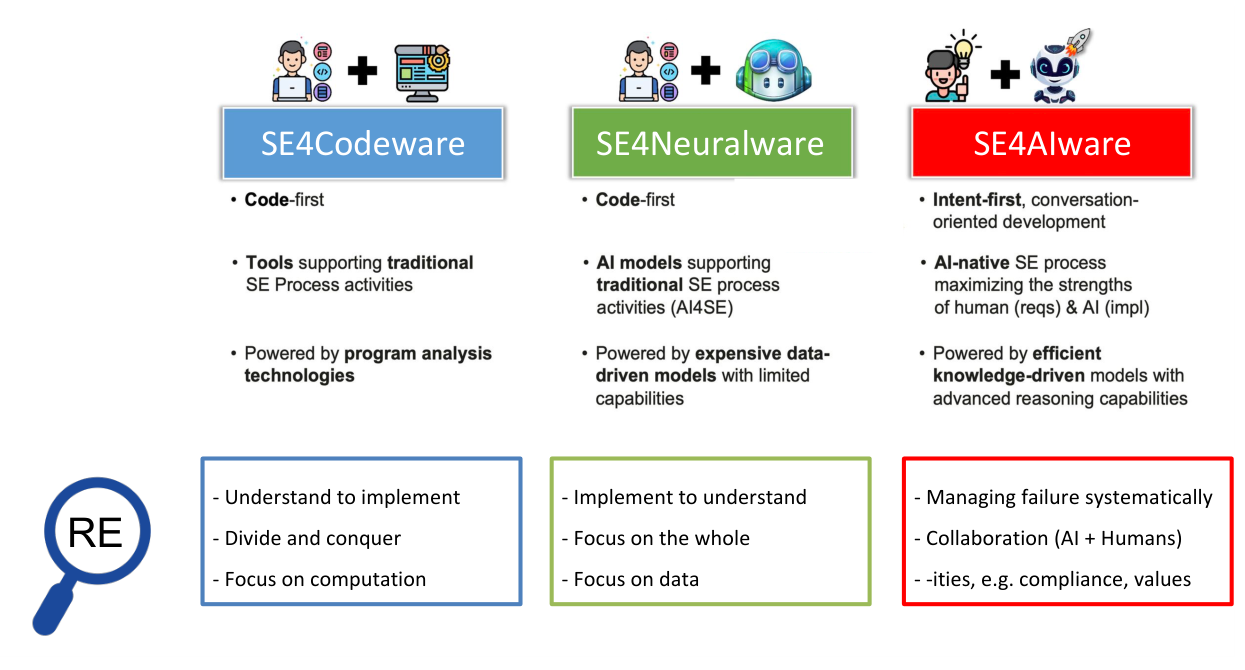
From Codeware to AIware: rethinking requirements, human-AI collaboration, and the engineering of trustworthy software.
Our discussions will explore:
- Requirements and intent: elicitation, negotiation, executable requirements, traceability, and validation at the pace of AI-assisted development.
- Human-AI collaboration: roles, trust, accountability, oversight, and shared decision-making.
- Engineering trustworthy AIware: assumptions, data and model alignment, failure analysis, compliance, and stakeholder values.
- Changing practice and education: adapting teams, processes, skills, and RE curricula.
An interactive workshop, a lasting community
We aim to bring some of the spirit of Dagstuhl to ICSE: time to think together, challenge assumptions, and develop ideas across disciplines. The programme will combine inspiring invited talks and a multidisciplinary panel with research presentations, demonstrations, and structured discussions shaped by participants’ interests.
Building on two previous editions, RAISE is growing a community connecting RE, software engineering for AI, human-centred software engineering, and responsible AI. Bring your results, practical experiences, early ideas, and open questions. Together, we will identify shared research priorities and opportunities for collaboration beyond the workshop.
Call for Papers
RAISE 2027 invites submissions to its third edition, focused on rethinking Requirements Engineering (RE) in the context of AI-powered software (AIware). We welcome research results, practical experiences, tools, datasets, and emerging ideas that can advance the field and stimulate discussion. Key topics include:
- Requirements as Code. Exploring how natural language prompts and executable specifications can express stakeholder intent, guide AIware development, and support validation of desired outcomes.
- RE for AIware. Developing RE practices for the AIware lifecycle, including data and model alignment, grounding, guardrails, cognitive architecture design, failure analysis, and performance engineering.
- Training AI Agents and Software Makers. Developing the skills software makers need to work effectively with AI agents, alongside methods for aligning agents with stakeholder needs, domain knowledge, and constraints.
- Human-AI Collaboration. Understanding how humans and AI agents share requirements-related work, decisions, and responsibilities, including implications for trust, accountability, regulatory compliance, safety, security, and user experience.
- Rethinking RE Education. Adapting RE curricula and professional training to prepare engineers for the technical, organisational, and human challenges of AIware development.
These topics are indicative. We welcome other relevant contributions to RE for AIware, including interdisciplinary perspectives that extend the boundaries of the field.
Types of Submissions
RAISE 2027 welcomes forward-looking and innovative contributions in the following categories:
- Technical contributions: Research papers presenting methods, models, frameworks, or empirical findings (up to 8 pages + 2 pages for references).
- Industrial experience reports: Accounts of practical challenges, approaches, and lessons learned (up to 6 pages + 1 page for references).
- Demos and datasets: Contributions presenting tools, prototypes, or datasets that support practical exploration and hands-on activities (up to 4 pages + 1 page for references).
- Discussion-oriented contributions: Early ideas, position statements, or open questions intended to stimulate discussion and shape future research (up to 2 pages + 1 page for references).
Submission Format and Requirements
All submissions must conform to the IEEE conference proceedings template, available from the IEEE Authoring Tools and Templates page. Use a 24pt title and 10pt main text. LaTeX users must use \documentclass[10pt,conference]{IEEEtran}, without the compsoc or compsocconf options. Submissions must be provided as PDF files and respect the page limits for their selected category, including the separate allowance for references.
Double-anonymous review. All submissions must be anonymised for double-anonymous review. Authors must:
- Omit author names and affiliations.
- Remove identifying acknowledgements and author information from the PDF metadata.
- Refer to their own previous work in the third person, without removing or anonymising bibliographic references.
- Anonymise linked repositories, datasets, and supplementary materials made available to reviewers.
Publication ethics and authorship. By submitting to RAISE 2027, authors acknowledge that they are aware of and agree to comply with the ACM Policy and Procedures on Plagiarism and the IEEE Plagiarism FAQ. Authors must also comply with the ACM Policy on Authorship and the IEEE authorship requirements, including applicable guidance on the use and disclosure of artificial intelligence tools. Authors remain responsible for the accuracy, originality, and integrity of all submitted content.
Review Process and Guidance
In the interests of transparency, and in line with the approach taken by many conferences and ICSE co-located events, we make our reviewing expectations explicit. Our aim is a constructive, inclusive review process that supports authors and helps build the RAISE community. Reviewers are asked to follow the guidance below.
-
Be positive and constructive. Look for reasons to accept work that can enrich the workshop. Acknowledge its strengths and provide specific, actionable suggestions for improvement. Use respectful, unbiased, and non-dismissive language that encourages authors to engage with the feedback.
-
Interpret the scope openly. Consider work that addresses concerns relevant to the RAISE community, even when it extends beyond traditional disciplinary boundaries. Interdisciplinary perspectives and contributions that open new directions are welcome.
-
Evaluate each submission according to its category. Match expectations to the contribution’s purpose, maturity, and page limit. In particular, assess discussion-oriented contributions for their clarity, relevance, and potential to stimulate productive debate. If the selected category does not match the content, recommend a more suitable category in the review.
-
Respect the reviewing and discussion schedule. The review period is just over two weeks, followed by less than one week for discussion and final decisions. Please reserve time for both reviewing and online discussion, and inform the chairs as early as possible if you can no longer meet these commitments.
-
Maintain confidentiality and use AI responsibly. Submitted papers, reviews, and online discussions must remain confidential. AI tools may be used to help draft or refine a review, provided that their use preserves this confidentiality. AI should support the reviewer’s own critical assessment and judgement, not replace them. Reviewers remain fully responsible for the accuracy, substance, and recommendations of their reviews.
-
Respect double-anonymous reviewing. Submissions will undergo double-anonymous review. During online discussion, PC members will be able to see reviews and reviewer identities for all submissions with which they have no conflict of interest. Any information inadvertently received about a conflicted submission must not be used or disclosed.
-
Declare conflicts promptly. If you are assigned a submission for which you have a conflict of interest, notify the chairs immediately so that it can be reassigned.
| Fri 13 Nov 2026 Abstract submission |
| Fri 20 Nov 2026 Paper Submission |
| Fri 11 Dec 2026 Paper Notification |
| Fri 29 Jan 2027 Camera Ready |
| Sun 25 Apr 2027 Tentative Workshop Date |
Amel BennaceurOrganization Co-chair
The Open University, UK
United Kingdom
Qinghua LuOrganization Co-chair
Data61, CSIRO
Australia
Foutse KhomhOrganization Co-chair
Polytechnique Montréal
Canada
Israa AbouelezzProceedings Chair
The Open University, UK
United Kingdom
Gopi Krishnan Rajbahadur
Centre for Software Excellence, Huawei, Canada
Fatma Başak Aydemir
Utrecht University
Netherlands
Luciano Baresi
Politecnico di Milano
Italy
Imen Benzarti
ETS Montreal, University of Quebec
Canada
Jean-Michel Bruel
Université de Toulouse, France
France
Lidiany Cerqueira
BRAVAS in Tech
Brazil
Kezia Devathasan
University of Victoria
Canada
Sunil Divvela
Amazon Web Services
United States
Sávio Freire
Federal Institute of Ceará and State University of Ceará
Brazil
Carlos Gavidia-Calderon
The Alan Turing Institute
United Kingdom
Jennifer Horkoff
Chalmers and the University of Gothenburg
Sweden
Khan Mohammad Habibullah
Mid Sweden University
Sweden
Bharadwaj Pendyala
Salesforce, USA
United States
Mona Rahimi
Northern Illinois University
United States