ICSE 2026
Sun 12 - Sat 18 April 2026 Rio de Janeiro, Brazil

2nd International Workshop on Neuro-Symbolic Software Engineering (April 12, 2026)

Software engineering has a successful history of evolving symbolic techniques, e.g., formal methods and programming languages, to solve challenging problems like providing safety and performance guarantees to autonomous intelligent systems fulfilling mission-critical functions. With the availability of machine learning (ML) techniques, software engineering expanded its set of problems to how learning from data enables new applications, e.g., code summarization & generation, automatic program repair, and & formal verification.

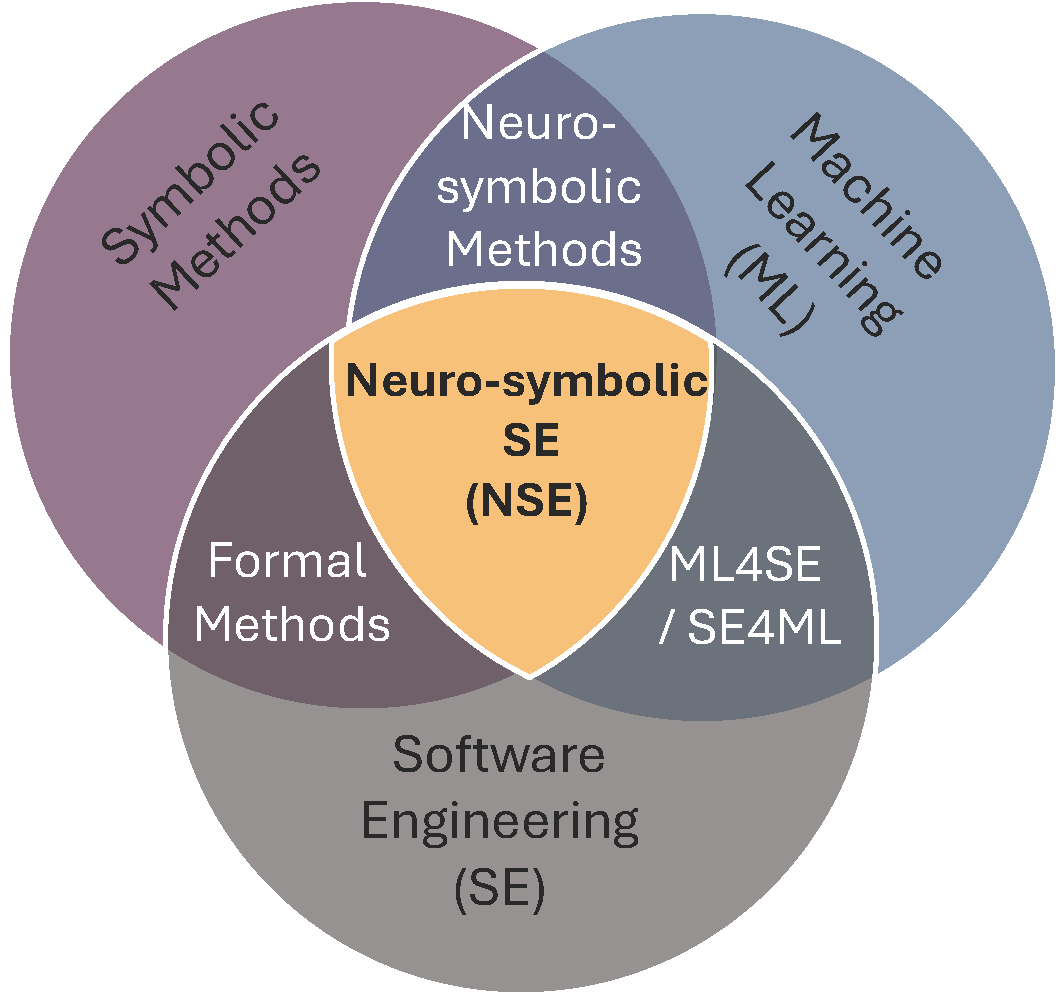
The integration of symbolic and ML techniques has opened novel methodological challenges that go beyond applying ML to build software (ML4SE) or applying software engineering to build ML (SE4ML). These challenges fall under the umbrella of Neuro-Symbolic methods and comprise problems of “how to reason about learning” and “how to learn about reasoning”.

The NSE workshop aims to discuss these problems in the context of software engineering tasks that have been transformed by the adoption of machine learning techniques. We invite insights on merging symbolic and ML techniques across the software development life-cycle, its activities, tasks, and tools. We welcome case studies, conceptual innovative approach descriptions, empirical research, and more formal or theoretical considerations.

Our goal is to collect experiences, challenges, and solutions involved in combining symbolic methods and machine learning to tackle new and traditional challenges of software engineering tasks from requirements to analysis & design, coding, testing, and maintenance & evolution. We welcome contributions in any of the following formats:

  • Research papers

  • Case studies

  • Proofs-of-concept

  • New ideas and emerging results

  • Evaluation of tools

  • Controlled experiment reports

Venn diagram with SE communities
Tracks
Plenary
You're viewing the program in a time zone which is different from your device's time zone change time zone

Sun 12 Apr

Displayed time zone: Brasilia, Distrito Federal, Brazil change

08:00 - 17:30
Sunday RegistrationSocial, Networking and Special Rooms at Main Entrance

Registration for ICSE 2026.

08:00
9h30m
Registration
ICSE 2026 Registration
Social, Networking and Special Rooms

09:00 - 10:30
NSE Opening and KeynoteNSE at Oceania VI
Chair(s): Sona Ghahremani Hasso Plattner Institute, University of Potsdam
09:00
10m
Day opening
NSE Opening and Welcome Notes
NSE
Sona Ghahremani Hasso Plattner Institute, University of Potsdam
09:10
60m
Keynote
Sustainable neural-symbolic artificial intelligence: is it possible to have the best from both (or all) worlds
NSE
Priscila Machado Vieira Lima Federal University of Rio de Janeiro (UFRJ)
10:10
20m
Talk
Neuro-Symbolic and Causal Reasoning for Software Verification and ValidationVirtual Attendance
NSE
Christian Medeiros Adriano Hasso Plattner Institute, University of Potsdam
10:30 - 11:00
Sunday Morning BreakCatering at Catering and Exhibition Hall (Europa I to IV)

This break will provide an opportunity for networking and relaxation between sessions.

10:30
30m
Coffee break
Break
Catering

11:00 - 12:30
NSE Session 2NSE / NLBSE at Oceania VI
Chair(s): Sona Ghahremani Hasso Plattner Institute, University of Potsdam
11:00
20m
Talk
Integrating Bayesian Reasoning and Evolutionary Search for Knowledge-Driven Team Formation
NSE
Felipe Cunha VIRTUS/UFCG, Mirko Perkusich VIRTUS, Danyllo Albuquerque VIRTUS/UFCG, Ramon Nóbrega dos Santos VIRTUS/UFCG, Kyller Costa Gorgônio Federal University of Campina Grande, Angelo Perkusich VIRTUS/UFCG
11:20
20m
Research paper
ASP-Bench: From Natural Language to Logic Programs
NSE
Stefan Szeider Vienna University of Technology (TU Wien)
11:40
15m
Talk
Code Generation for Domain-Specific Programming Languages: Learnings and Outlook for Neuro-Symbolic ApproachesVirtual Attendance
NSE
Ruben Ruiz-Torrubiano IMC Krems University of Applied Sciences
Media Attached
11:55
5m
Day closing
Closing and Final Remarks
NSE
Christian Medeiros Adriano Hasso Plattner Institute, University of Potsdam, Ruben Ruiz-Torrubiano IMC Krems University of Applied Sciences, Sona Ghahremani Hasso Plattner Institute, University of Potsdam
12:00
5m
Day opening
NLBSE Opening
NLBSE

12:05
25m
Talk
Keynote: "Answering Questions About Open Source Projects" — Marco A. Gerosa (Northern Arizona University, USA)
NLBSE

12:30 - 14:00
Sunday LunchCatering at Catering and Exhibition Hall (Europa I to IV)

Lunch time with a variety of meal options available for attendees, including vegetarian choices. This session will provide an opportunity for attendees to enjoy a meal while networking with colleagues and discussing the day’s events.

12:30
90m
Lunch
Lunch
Catering

14:00 - 15:30
NLBSE Research PapersNLBSE at Oceania VI
Chair(s): Fabio Marcos De Abreu Santos Colorado State University, USA
14:00
30m
Keynote
Beyond Off-the-Shelf: Building Reliable NLP Tools for Software Engineering
NLBSE
K: Nicole Novielli University of Bari
14:15
15m
Paper
From Issues to Insights: RAG-based Explanation Generation from Software Engineering Artifacts
NLBSE
A: Daniel Pöttgen University of Cologne, A: Mersedeh Sadeghi University of Cologne, A: Max Unterbusch University of Duisburg-Essen, A: Andreas Vogelsang paluno – The Ruhr Institute for Software Technology, University of Duisburg-Essen
14:45
15m
Short-paper
Bridging Communication Gaps: Inclusive Conversational Agents for Requirement EngineeringVirtual Attendance
NLBSE
Media Attached
15:00
10m
Paper
Automating Metadata Extraction from Software Engineering Contracts Using a RAG FrameworkVirtual Attendance
NLBSE
A: Momojit Biswas TCS Research, A: Chirag Jain TCS Research, A: Preethu Rose Anish TCS Research
15:10
10m
Short-paper
How should self-deprecation comments be classified? A toxicity analysis study on Zephyr
NLBSE
A: Satyanarayana Chowdary Kadiyala Colorado State University, A: Jaydeb Sarker University of Nebraska Omaha, A: Bianca Trinkenreich Colorado State University
15:20
10m
Product announcement
NLBSE Awards and Message from the Chairs
NLBSE
P: Giuseppe Colavito University of Bari, Italy, P: Nataliia Stulova MacPaw, P: Fabio Marcos De Abreu Santos Colorado State University, USA
15:30 - 16:00
Sunday Afternoon BreakCatering at Catering and Exhibition Hall (Europa I to IV)

Afternoon Break with a variety of beverages and snacks available for attendees. This break will provide an opportunity for networking and relaxation between sessions.

15:30
30m
Coffee break
Break
Catering

16:00 - 18:30
NLBSE ToolsNLBSE at Oceania VI
Chair(s): Fabio Marcos De Abreu Santos Colorado State University, USA, Moritz Mock Free University of Bozen-Bolzano
16:00
5m
Day opening
NLBSE Tool Competition Opening
NLBSE

16:05
7m
Short-paper
High-quality data augmentation for code comment classification
NLBSE
A: Thomas Borsani , A: Andrea Rosani Free University of Bozen-Bolzano, A: Giuseppe Di Fatta
16:12
7m
Short-paper
TraCC: Efficient Multi-Label Code Comment Classification Through Knowledge Distillation and Adaptive ThresholdingVirtual Attendance
NLBSE
A: Pir Sami Ullah Shah FAST National University, A: Abdullah Ashfaq National University of Computer & emerging Sciences (FAST-NUCES), A: Ahmed Fasseh National University of Computer & emerging Sciences (FAST-NUCES), A: Dilawar Shah National University of Computer & emerging Sciences (FAST-NUCES)
16:19
7m
Short-paper
X-LoRA MME: Multi-Model Ensemble with Mixture of Experts for Code Comment ClassificationVirtual Attendance
NLBSE
16:26
7m
Short-paper
Distilling Semantics: Efficient Multi-label Code Comment ClassificationVirtual Attendance
NLBSE
A: Muhammad Abdul Majeed National University of Computer & emerging Sciences (FAST-NUCES), A: Ahmed Bin Asim National University of Computer & emerging Sciences (FAST-NUCES)
16:33
5m
Product announcement
NLBSE Tool Competition Awards and Closing
NLBSE
C: Moritz Mock Free University of Bozen-Bolzano, C: Pooja Rani University of Zurich
16:38
1h50m
Tutorial
NLBSE NVIDIA Tutorial: Building an LLM-based coding copilot
NLBSE
18:28
2m
Day closing
NLBSE Closing
NLBSE
P: Fabio Marcos De Abreu Santos Colorado State University, USA

Call for Papers

Goals

The integration of symbolic and ML techniques has opened new novel methodological challenges that go beyond applying Machine Learning (ML) to build software (ML4SE) or applying software engineering to build ML (SE4ML). These challenges fall under the umbrella of Neuro-Symbolic methods and comprise problems of “how to reason about learning” and “how to learn about reasoning”. NSE aims to discuss these problems in the context of software engineering tasks, which in turn have been the subject of innovation through the adoption of machine learning techniques. To illustrate that, we selected a broad non-exclusive list of topics (see below). Ultimately, this workshop invites insights on merging symbolic and ML techniques across the software development life-cycle, its activities, tasks, and tools. We welcome case studies, conceptual innovative approach descriptions, and empirical research that explore how formal reasoning can benefit from learning from data, e.g., trimming combinatorial search spaces, reconfiguring symbolic representations, generating new rules, etc. Conversely, we look forward to contributions that discuss how learning from data can be improved by being steered by reasoning, e.g., regularization, shaping goals/rewards, ensemble learning, etc. If you are also excited about any of these perspectives, please join us in shaping the future of software engineering.

NSE seeks submissions describing novel research, emerging ideas, and work-in-progress describing original and unpublished results in the field of Neuro-symbolic methods for software engineering.

Topics

  • Neuro-symbolic methods in automated software engineering tools, e.g., code & test generation, bug fixing, code summarization, code review, etc.
  • Neuro-Symbolic agents to support collaboration and decision making in software teams.
  • Neuro-Symbolic methods in validation and verification tools.
  • Neuro-Symbolic methods for designing safety-mission-critical systems.
  • Neuro-Symbolic methods for extracting and maintaining knowledge graphs for software engineering.
  • Methods for reasoning about learning from software data.
  • Methods for learning while reasoning about software, e.g., automatically & adaptively determining decision thresholds and magnitude of actions for a desired effect of a software tool & technique.
  • Methods for applying prior symbolic or probabilistic knowledge to new or improved software tools & methods.
  • Formal methods in neuro-symbolic software engineering.
  • Theoretical frameworks or formal guarantees for neuro-symbolic systems

Important Dates

  • Paper submissions: October 20th, 2025 November 10th, 2025.
  • Paper notifications: November 24th, 2025 Decemebr 8th, 2025.
  • Camera-ready versions: January 26th, 2026.
  • Workshop day: Sunday, 12 April 2026.

Guidelines

We invite three different types of submissions this year:

  • Full papers (research): up to 8 pages
  • Short papers (research, experience, or industry demonstration): up to 6 pages
  • Extended abstracts: up to 5 pages. These are free of APC (article processing charge).

Submissions must be in English, in PDF format, and must not exceed the page limits (including references and appendices) listed above. Submissions should be made via HotCRP and strictly conform to the ACM conference proceedings formatting instructions, using the double-column format.
There is no limit on the number of submissions an author may submit. We will follow a single-blind process, i.e., anonymizing the submission is not required.

Other detailed submission policies and formatting guidelines are aligned with the ICSE 2026 Research Track submission process.

Priscila Machado Vieira Lima

Priscila Machado Vieira Lima


Title: Sustainable neural-symbolic artificial intelligence: is it possible to have the best from both (or all) worlds

Abstract

The past few years have witnessed a fantastic growth of artificial intelligence capabilities. Such progress has been accompanied by big challenges, especially with respect to the environmental impact of training and the control of what is learnt. The first issue has been addressed by the investigation of lookup tables (LUTs) as lower energy consumption machine learning mechanisms, while problems related to the second have been mitigated by endowing intelligent systems with interpretability and explainability. We propose that a family of LUT-based methods, the Weightless Neural Networks variants derived from the Wilkie Stonham Aleksander Recognition Device (WiSARD), be the answer to these demands, and also to federated learning, data-stream clustering, among others.


Biography

Prof. Priscila Machado Vieira Lima is a professor at Alberto Luiz Coimbra Institute for Graduate Studies and Research in Engineering (Coppe) and Tércio Pacitti Institute for Computational Applications and Research (NCE) at the Federal University of Rio de Janeiro (UFRJ) in Brazil. She received her Ph.D. in 2000 from Imperial College, London. Prof. Lima is the Chair of Artificial Intelligence of the Brazilian School of High Studies of UFRJ and has research concentration in neuro-symbolic systems, weightless neural systems, integration of artificial intelligence, and optimization.